
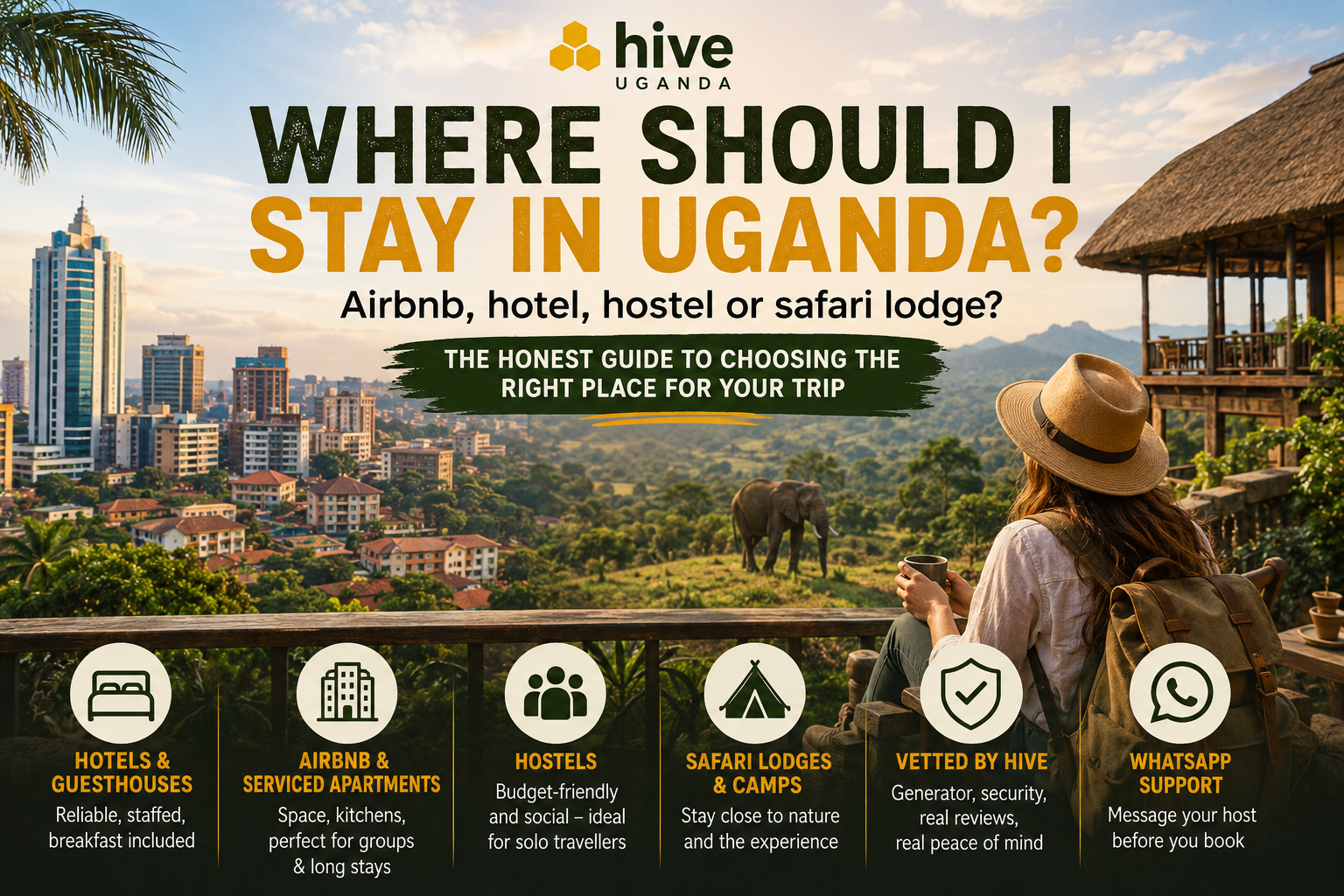
"Where should I stay in Uganda" usually gets answered with a neighbourhood. But there's a question underneath it that matters just as much, and almost nobody asks it out loud: what type of place should you book? Airbnb, hotel, guesthouse, serviced apartment, safari lodge — they are not interchangeable here the way they might be in Europe, and the right answer changes completely depending on whether you're a solo traveller in Kampala for two nights, a family of five for two weeks, or a couple heading to Bwindi for the gorillas.
Pick the wrong category and it costs you — in money, in location, or in a working shower and a charged phone at a moment that matters. This is the honest comparison, type by type, with the Uganda-specific catches that generic "Airbnb vs hotel" articles never mention.
The short version
- Solo or couple, short city stay: a guesthouse or small hotel usually wins — reliable, staffed, breakfast included.
- Solo and want to meet people: a hostel beats everything (see our best hostels in Kampala guide).
- Group or family, or any stay over a week: a whole Airbnb or serviced apartment is the value play.
- Anywhere near a national park: you're booking a lodge or tented camp, and that's a good thing — the lodge is half the experience.
Now the detail.
Hotels & guesthouses — the city workhorse
In Kampala and Entebbe, small hotels and guesthouses are the default for good reason. They're abundant, they span every budget from $20 guesthouses to the colonial-elegant Emin Pasha and the five-star Serena, and crucially they come with the things that quietly matter most in Uganda: a backup generator for when the power cuts, a water tank for when supply drops, on-site staff who'll sort your boda, your laundry and your airport transfer, and usually breakfast included. Boutique mid-range options like Emin Pasha or Humura Resort show the sweet spot — 18-to-20-room properties with gardens, a pool, a restaurant and proper service.
Best for: First-timers, solo travellers, couples, anyone on a short city stay who values reliability and zero hassle over space. The catch: Quality varies wildly between listings on the same street, and the reviews matter more than the photos. You're also paying per room, so it gets expensive for groups.
Airbnb & serviced apartments — space, kitchens, groups
Whole apartments and serviced flats shine in two specific situations. The first is groups and families: split a two- or three-bedroom apartment four or five ways and it comfortably undercuts the equivalent in hotel rooms, and you get a shared living space instead of everyone retreating to separate boxes. The second is long stays: once you're past about five nights, a kitchen and a washing machine genuinely change the maths and the comfort.
Airbnb is well established across Uganda — strong clusters of apartments near Acacia Mall and in Kololo, Bukoto, Ntinda, Muyenga and Kisaasi, lakeside villas around Entebbe and Munyonyo, and even cabins and eco-lodges out near Bwindi, Murchison and the crater lakes of Fort Portal. Aparthotels (like studios at Kabira Country Club in Bukoto) blur the line nicely — apartment independence with hotel services, a generator, security and breakfast bundled in.
The catches that are specific to Uganda — read these before you book a self-catering place:
- Confirm the backup generator and water tank. Load-shedding and water interruptions are real, and a self-catering flat with no staff means no one to fix it when the power dies mid-evening. The best listings advertise "generator" and "24-hour security" precisely because guests have learned to look for them.
- Clarify the key handover. No front desk means someone has to physically meet you — pin down exactly who, where and when, especially for a late arrival.
- A quiet-looking listing can sit on a loud road. Ask, or check reviews for noise.
- Confirm security. Look for a gated compound or 24-hour guard — standard at good Kampala properties.
Best for: Groups, families, digital nomads, long-stay travellers. Less good for: solo first-timers who'd genuinely benefit from on-site help and a front desk.
Hostels — the budget and social option
If you're solo and want to meet people, a hostel beats a private rental every time, because the social scene is the point — the bar, the pub quiz, the travel desk, the strangers who become your safari group. Dorm beds run roughly $10–$20, with private rooms available too. We cover the best ones in depth in the best hostels in Kampala guide.
Best for: Solo travellers, backpackers, anyone prioritising budget and company. Less good for: light sleepers, couples wanting privacy, families.
Safari lodges & camps — non-negotiable near the parks
Out at Bwindi, Murchison Falls, Queen Elizabeth or Kidepo, the accommodation is part of the trip, and you'll be choosing a lodge or tented camp by budget tier rather than picking between an Airbnb and a hotel:
- Budget / community camps: roughly $40–$125 per person, often run with local communities, simple but well-placed.
- Mid-range lodges: comfortable rooms, hot water, good food, strong locations near the gates — the sweet spot for most travellers (think Mahogany Springs at Bwindi, Katara at Queen Elizabeth).
- Luxury lodges & tented camps: up to $500+ per night, where wildlife sometimes wanders across the lawn and the setting alone justifies the trip.
The single most important factor out here isn't luxury, it's proximity to the park gate or trailhead — a lodge near the Buhoma gorilla-trekking point can save you a brutal pre-dawn drive. Our best safari lodges guide breaks it down park by park, and the complete safari guide puts it all in context.
A quick decision table
| Your situation | Book this |
|---|---|
| Solo, short city stay | Guesthouse or small hotel |
| Solo, want to meet people | Hostel |
| Couple, short city stay | Boutique hotel or guesthouse |
| Group or family in the city | Whole Airbnb / serviced apartment |
| Staying 2+ weeks / working remotely | Serviced apartment or aparthotel |
| Anywhere near a national park | Lodge or tented camp |
Booking-platform reality check
A few things worth knowing about how booking actually works in Uganda:
- Many budget places want cash on arrival, even ones listed online — confirm the payment method so you're not caught out.
- Photos can be old. This is the single most common complaint across all categories; recent reviews are your best defence.
- "In Kololo" can mean "near Kololo." Listings sometimes borrow a smarter neighbourhood's name — check the actual pin, not just the title. (Our where to stay in Kampala guide explains which hills are which.)
- WhatsApp is the real customer service channel. Most Ugandan hosts and hotels respond faster there than by email — being able to message before you pay is genuinely useful.
Book it vetted, whatever the type
HIVE lists all of these — hostels, hotels, Airbnbs and lodges — and every single one is checked in person by a local host, so the category you choose actually delivers what it promises: the generator works, the photos are current, the "Kololo" listing is in Kololo. Filter by type, price or Long-stay, and message the host on WhatsApp before you commit.
Frequently asked questions
Is Airbnb or a hotel better in Kampala? For solo travellers and couples on short stays, a guesthouse or small hotel is usually better value and far less hassle — staffed, with breakfast, a backup generator and a water tank. Airbnb and serviced apartments win for groups and stays over about a week, where a whole apartment with a kitchen beats multiple hotel rooms on both cost and comfort.
Is Airbnb safe and legal in Uganda? Yes, Airbnb operates normally and widely in Uganda, mainly in Kampala, Entebbe and near the national parks. Before booking a self-catering place, confirm it has a backup generator, a water tank and 24-hour security or a gated compound, and clarify exactly how you'll collect the keys, since there's no front desk.
Do I need to book a lodge for a safari? Effectively yes. Near the national parks, lodges and tented camps are the main accommodation, ranging from community-run budget camps around $40–$125 per person to luxury lodges over $500 a night. Prioritise proximity to the park gate or trailhead over luxury — it saves you the pre-dawn drive.
What's the cheapest type of accommodation in Uganda? Hostel dorm beds, at roughly $10–$20 a night, followed by budget guesthouses (some with private en-suite rooms from around UGX 50,000 / $13). Community campsites near the parks are the cheapest safari option.
Are serviced apartments good for long stays in Uganda? Yes — they're the best option for stays over a week or for remote work. You get a kitchen, a washing machine, more space and often a generator, security and Wi-Fi bundled in, frequently at a lower nightly rate than a hotel. Look in Bukoto, Ntinda, Naguru, Muyenga and around Kololo.
Can I pay by card, or do I need cash? Hotels and higher-end properties take cards, but many budget guesthouses and some Airbnbs expect cash on arrival, often in Ugandan shillings or US dollars. Always confirm the payment method when you book, and carry some cash as backup.