
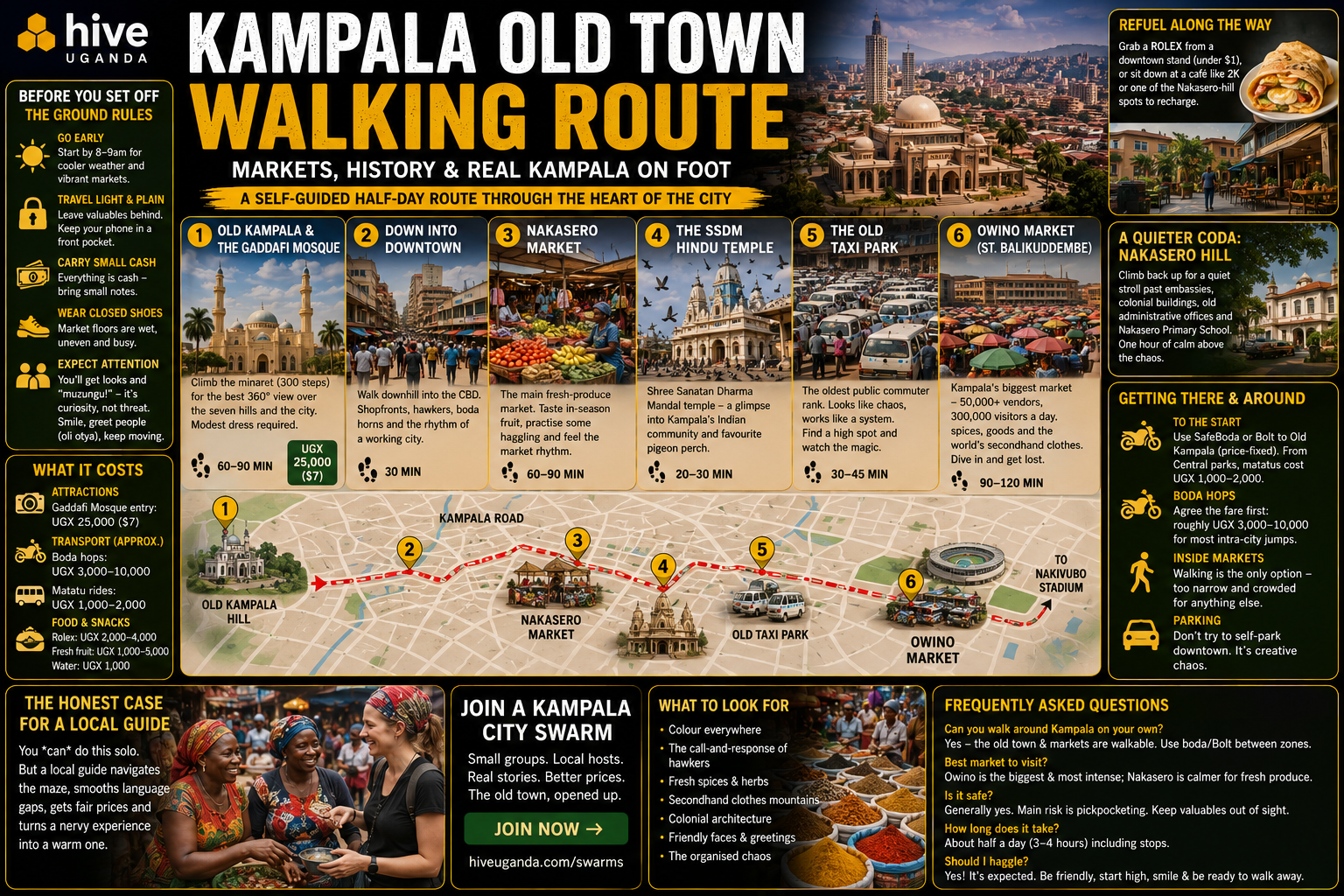
The best way to understand Kampala isn't from a car window — it's on foot, down in the old town, where the city is loudest and most itself. The markets, the taxi park, the spice lanes, the colonial bones of Nakasero hill: this is the real Kampala, and almost none of it is more than a walk apart.
This is a self-guided walking route you can follow on your own, in roughly half a day, hitting the highlights of the old town and the two great markets in a logical line. We'll tell you the order, what to look for at each stop, how to handle the markets like you've done it before, and exactly what it costs. A heads-up first, though: the central markets are genuinely intense — a guide makes them easier and a lot more meaningful, and we'll come back to that. For the wider city picture, pair this with our things to do in Kampala master list.
Before you set off: the ground rules
A few things that make the difference between a great morning and a stressful one:
- Go early. Start by 8–9am. The markets are at their most vibrant in the morning, the air is cooler, and the light is better. By midday it's hot and heaving.
- Travel light and plain. Leave the good camera, jewellery and obvious valuables at your stay. Carry a phone you're relaxed about, and keep it in a front pocket. Pickpocketing in the crowds is the realistic risk — not danger, just opportunism.
- Carry small cash. Bring modest notes for snacks, crafts and boda hops. Everything down here is cash.
- Wear closed shoes. Market floors are wet, uneven and busy.
- Expect attention. As a visitor — especially a foreign one — you'll get curious looks, the odd "muzungu!", maybe a friendly touch on the arm. It's overwhelmingly curiosity, not threat. Smile, greet people ("oli otya" — how are you), keep moving.
The route, stop by stop
The walk runs roughly from Old Kampala hill down into the downtown markets, ending at the great chaos of Owino. It's about 3–4 km of actual walking, but you'll spend most of your time stopped and gawking.
Stop 1 — Old Kampala & the Gaddafi National Mosque
Start high, for the orientation. Old Kampala hill was the colonial administrative centre and is now home to the Uganda National Mosque (the Gaddafi Mosque), East Africa's largest. The guided visit and the climb up the minaret (around 300 steps) give you a 360-degree view over the seven hills — the single best way to understand the city's layout before you descend into it. Entry is around UGX 25,000 ($7); modest dress required, wraps provided for women. Full detail in our things to do guide.
Stop 2 — Down into downtown
Walk downhill into the central business district. This stretch is the city working: shopfronts, hawkers, hardware arcades, money changers, the constant percussion of boda horns. Don't rush it — this is the sightseeing. You're heading toward Nakasero.
Stop 3 — Nakasero Market
At the foot of Nakasero hill sits Nakasero Market, the city's main fresh-produce market — a riot of in-season fruit, vivid vegetables, tubers, eggs, halal meat and fish. It's busy but more manageable than Owino, which makes it the perfect warm-up. Taste whatever's in season (a vendor will happily cut you a piece), practise a little friendly haggling, and get used to the rhythm. Tip: mid-morning, vendors are cheerful and ready to deal; on a slow afternoon they wait you out.
Stop 4 — The SSDM Hindu Temple
A short walk away stands the Shree Sanatan Dharma Mandal (SSDM) temple, a window into Uganda's significant Indian community and its long history in the country — and, as locals will grin and tell you, the city's favourite pigeon perch. A calm, fascinating pause amid the downtown noise.
Stop 5 — The Old Taxi Park
This is the one that sounds dull and turns out to be unforgettable. Kampala's Old Taxi Park is the oldest public commuter rank in the city — hundreds of white-and-blue matatus packed into a single basin in what looks like total bedlam but is, somehow, a working system. Find a vantage point above it (a surrounding building or upper walkway) and just watch the organised chaos for a few minutes. It's also ringed by street-food vendors if you need fuel.
Stop 6 — Owino Market (St. Balikuddembe)
End at the big one. Owino, officially St. Balikuddembe Market, is the largest market in Kampala and one of the largest in Africa — over 50,000 vendors (around 70% of them women), an estimated 300,000 visitors a day, and a maze-like sprawl around Nakivubo Stadium that you genuinely could get lost in. It started in 1971 when 320 traders were relocated from Nakasero, and it's grown into a city within the city: spices and herbs, pots and pans, trinkets, and above all the world's secondhand clothes (this is where the West's donated clothing ends up — a vast, fascinating thrift universe). Dive in, follow the lanes, haggle hard and good-naturedly, and accept that you'll lose your bearings. That's the experience.
Where to refuel
You'll have earned a meal. Grab a Rolex from a downtown stand (chapati and egg, under $1), or for a sit-down break head up toward a café like 2K or one of the Nakasero-hill spots. For the city's best budget eats, our 12 best cheap eats in Kampala guide has the map.
A quieter coda: Nakasero hill's colonial quarter
If you've got energy left and want a complete contrast, climb back up into the upper blocks of Nakasero hill. One slow hour on foot takes you past embassies, Kampala's best-preserved colonial buildings, the old administrative offices and Nakasero Primary School — the lanes go quiet, the chaos stays pinned below, and you see the other, calmer face of the city. A lovely way to decompress after Owino.
Getting there and around
- To the start: From Kololo or Naguru, tap SafeBoda or Bolt to Old Kampala — easiest and price-fixed. From the central matatu parks, shared matatus run across town for UGX 1,000–2,000.
- Boda hops between stops if you tire: agree the fare first, roughly UGX 3,000–10,000 for most intra-city jumps.
- Inside the markets, walking is the only option — far too narrow and crowded for anything else.
- Don't try to self-drive and park down here. Central parking is, charitably, creative chaos.
The honest case for a local guide
You can do this walk solo, and this guide gives you everything to try. But the markets — Owino especially — are a different beast with someone who knows them: they navigate the maze, smooth any language gaps, get you fair prices, and turn a slightly nervy experience into a genuinely warm one. Several excellent women-led walking tours exist and are ideal for solo travellers (see our solo female travel in Uganda notes).
That's exactly what HIVE's city swarms are for — a small group, a Kampalan who actually knows the lanes, and the old town opened up properly rather than survived.
Frequently asked questions
Can you walk around Kampala on your own? Parts of it, yes — the old town and markets are walkable and this self-guided route links the highlights in about half a day. But Kampala is sprawling, hilly and traffic-heavy, so you'll use bodas or ride apps between zones, and inside the markets walking is the only option. Go early, travel light, and keep valuables out of sight.
What is the best market to visit in Kampala? Owino (St. Balikuddembe) is the largest and most overwhelming — 50,000+ vendors, famous for secondhand clothes and a maze-like layout. Nakasero Market is smaller, calmer and best for fresh produce, spices and an easier first taste of market life. Visiting both, Nakasero first, is the classic route.
Is it safe to walk through Kampala's markets? Generally yes. The realistic risk is pickpocketing in the crowds, not violence, so keep your phone in a front pocket, leave valuables at your stay, and stay aware. You'll get curious looks and the occasional friendly touch — it's curiosity about a visitor, not a threat. A local guide makes the markets much easier and more relaxed.
How long does a Kampala walking tour take? A self-guided loop through the old town and both markets takes roughly half a day (3–4 hours), depending on how long you linger. Add an hour if you climb the Gaddafi Mosque minaret at the start or explore Nakasero hill's colonial quarter at the end.
How do I get to Owino Market? It's in the heart of downtown near Nakivubo Stadium. From the city centre it's a short boda ride (UGX 3,000–10,000, agree the fare first) or a 10-minute walk east. From elsewhere, use SafeBoda or Bolt, or take a matatu heading to Kampala Central.
Should I haggle in Kampala markets? Yes, and it's expected — especially at Owino, where prices start high and drop with friendly bargaining. Keep it good-natured, smile, and be willing to walk away. Mid-morning is the best time, when vendors are cheerful; on a slow afternoon they'll often take a lower offer rather than lose the sale.
