
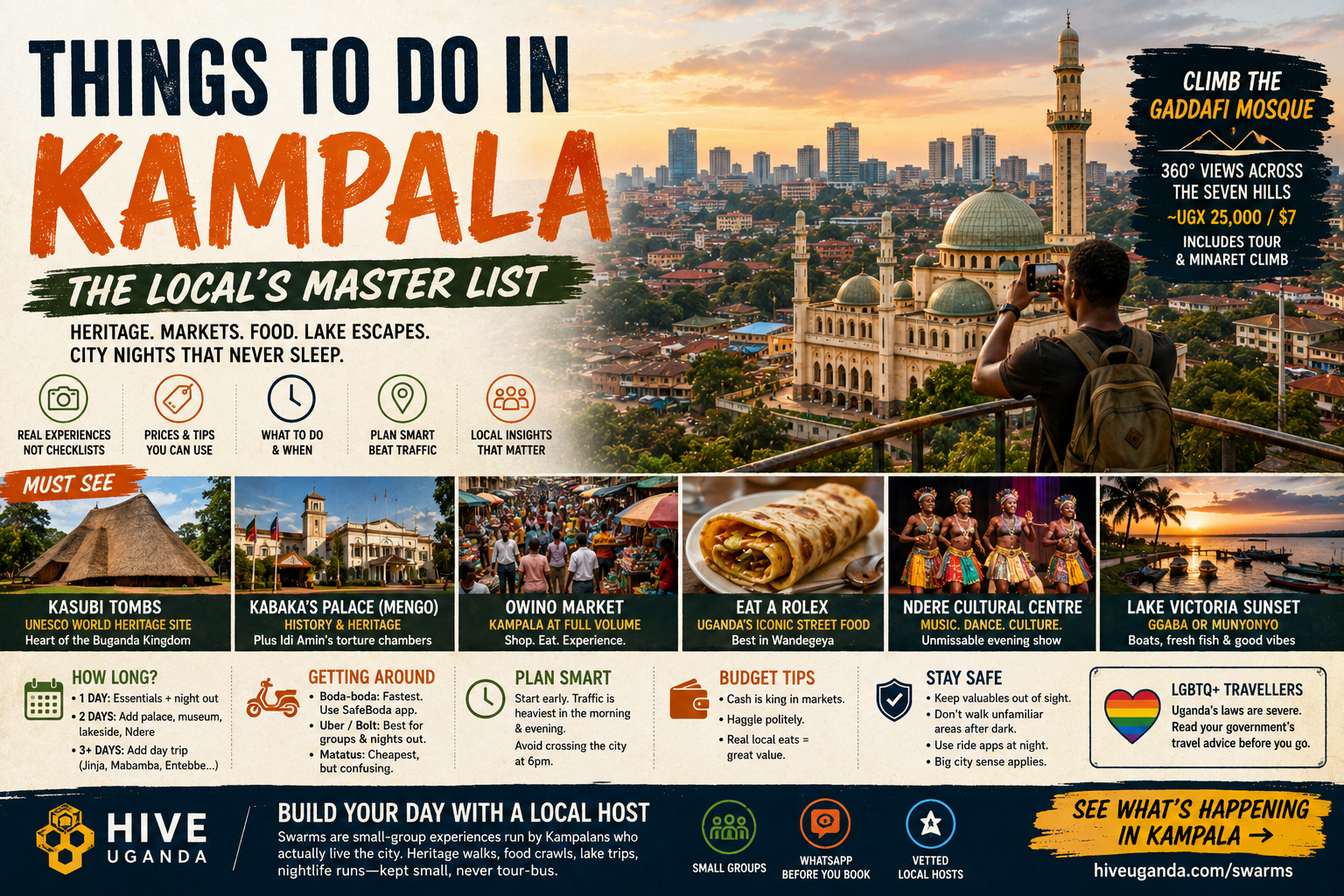
Kampala doesn't hand itself over easily. There's no single must-see monument you photograph and tick off; the city itself is the attraction — the markets, the boda chaos, the food, the hills, the way a quiet afternoon dissolves into a long night without anyone deciding it should. First-timers who treat it as a checklist often leave underwhelmed. Treat it as a place to get pleasantly lost and it becomes one of the most rewarding cities in East Africa.
That said, there is a real list of things worth your time here — heritage sites that explain the whole country, markets that overwhelm in the best way, viewpoints, lake escapes and a nightlife scene that's earned Kampala its "city that never sleeps" reputation. This is the local's master list: what's genuinely worth doing, what it costs, when to go, and how to string it into a day that doesn't leave you stuck in traffic for half of it.
The essentials — if it's your first time
Climb the Gaddafi National Mosque
The Uganda National Mosque (still universally called the Gaddafi Mosque, after the Libyan leader who funded it) sits atop Old Kampala Hill and is the single best thing to do first, because it orients everything else. It's the largest mosque in East Africa, seating over 20,000, and the guided visit ends with a climb up the minaret — around 300 winding steps — to a 360-degree panorama over the city and its original seven hills. Non-Muslim visitors pay roughly UGX 25,000 (about $7), which includes the interior tour and the climb (per Traveltomtom's 2026 visit). Dress modestly; women are given a wrap at the entrance. Late afternoon gives you the best light for the view.
Walk through the Kasubi Tombs
A UNESCO World Heritage Site and the only one inside Kampala — and the spiritual heart of the Buganda Kingdom the city grew around. The Kasubi Tombs, on Kasubi hill northwest of the centre, are the burial ground of four Buganda kings (Mutesa I, Mwanga II, Daudi Chwa II and Sir Edward Mutesa II). The central structure, Muzibu Azaala Mpanga, is built entirely from organic materials — reed, thatch, bark cloth — and was painstakingly restored after a 2010 fire. It's a living site, not a static monument: kingdom personnel still carry out centuries-old traditions here, and on-site guides unpack the history, clans and customs. Our Buganda Kingdom guide goes far deeper on why it matters.
See Kabaka's Palace (Mengo) and Idi Amin's torture chambers
The Kabaka's Palace at Mengo (Lubiri) is the seat of the Buganda kingdom, but its darkest draw is underground: the chambers Idi Amin used as a torture and execution site in the 1970s, still bearing prisoners' messages on the walls. It's a sobering, important counterpoint to the royal pageantry — guides cover both the kingdom's history and this brutal chapter.
Get lost in a market
No visit is complete without a market. Owino (St. Balikuddembe) is the big one — Kampala's busiest, most chaotic open-air market, a wall of fabric, produce, secondhand everything and street food. Nakasero Market is calmer and good for spices, produce and a gentler browse. This is the city at full volume; go with your wits about you and your phone tucked away. Our walking tour of the old town and markets maps a route through it.
Eat a Rolex
The chapati-and-egg roll that's effectively the national snack, and a rite of passage. Wandegeya — the student quarter near Makerere University — is its spiritual home, and you'll find stands griddling them all over the city. Our Ugandan food culture guide explains the dish and where to find the best.
If you have a free afternoon
Ndere Cultural Centre. The best single evening of culture in the city — the Ndere Troupe performs music and dance from across Uganda's regions on scheduled nights (often Wednesday, Friday and Sunday — confirm current showtimes), spectacular and genuinely informative, with food available. Our cultural experiences in Uganda guide sets the context.
The Uganda Museum. Founded in 1908, the oldest museum in East Africa — dated in a charming way, with ethnographic exhibits, archaeological artefacts and a collection of traditional musical instruments you can sometimes play. Cheap and underrated.
Lake Victoria at Ggaba or Munyonyo. The city forgets it sits beside the world's second-largest freshwater lake until you go to the shore — boats, fresh tilapia, sunsets. Munyonyo has the polished resort end; Ggaba is the working landing site with more local energy.
The Bahá'í Temple (Mother Temple of Africa). The only Bahá'í House of Worship on the continent, set in serene hilltop gardens north of the city — a quiet, green antidote to the downtown crush, free to enter.
Craft shopping. For genuine craft over airport tat, the craft markets on Buganda Road and at Exposure Africa (city centre) have baskets, bark cloth, art and textiles. Free to browse; haggle politely.
If you're into food and drink
Kampala eats well and cheaply. Start with our 12 best cheap eats for the under-the-radar spots, then graduate to the Kisementi and Acacia Avenue strips in Kololo for everything from Ethiopian to wood-fired pizza, plus the casual local-chain favourites. For the meaning behind the dishes — matoke, groundnut sauce, luwombo — the food culture guide is your primer.
If you're staying out late
This is where Kampala genuinely excels, and it's no exaggeration to call it the city that never sleeps. The scene runs harder and later than most visitors expect, peaking Thursday to Saturday around Kololo, Bugolobi, Kabalagala and the Industrial Area clubs. See the complete guide to Kampala nightlife for the full map, where to party in Kampala for the night-by-night, and date night in Kampala if it's a two-person mission. Short version: don't schedule anything important for the next morning.
If you want to leave the city for a day
Kampala is a superb base for escapes. The source of the Nile and adventure sports at Jinja, the waterfalls of Sipi, the islands of Lake Bunyonyi, and — for birders — the Mabamba wetlands, where you can paddle out to spot the prehistoric-looking shoebill stork. Ziwa Rhino Sanctuary, the only place to see rhinos in Uganda, also makes a long day or a stop en route to Murchison. Our day trips from Kampala guide lays out eight with realistic timings — because "two hours away" rarely is.
How long do you need in Kampala?
- One day: Gaddafi Mosque, Kasubi Tombs, a market, a Rolex, and a night out.
- Two days: Add Kabaka's Palace, the Uganda Museum or Bahá'í Temple, a lakeside afternoon, and an evening at Ndere.
- Three+ days: Add a day trip — Mabamba for the shoebill, Jinja for the Nile, or Entebbe and the lake.
Most travellers use Kampala as a hub between the western safari parks and the eastern adventure activities, so even a packed two days slots neatly into a bigger Uganda trip.
Getting around — the practical bit
Kampala is sprawling, hilly and traffic-choked, so it's only partly walkable. Your options:
- Boda-bodas (motorcycle taxis): fastest through jam. Use the SafeBoda app — it fixes the price and gives you a helmet.
- Ride-hailing cars (Uber, Bolt): best for groups, longer hops and nights out.
- Matatus (shared minibus taxis): the cheapest local way to move, but bewildering for first-timers.
Two rules save the most grief: start sightseeing early, before the heat and the worst traffic, and plan your day so you're not crossing the whole city at 6pm. Standard big-city sense applies — keep valuables out of sight, especially in markets, and use ride apps rather than walking unfamiliar areas after dark.
A note for LGBTQ+ travellers
Be aware that since the 2023 Anti-Homosexuality Act, Uganda's legal and social environment for LGBTQ+ people is severe. Travellers should read their home government's official travel advice carefully before planning a trip.
Build your day with a local host
HIVE's "Swarms" are small-group experiences run by Kampalans who actually live the city — heritage walks, market-and-food crawls, lake trips and nightlife runs, kept small so it never feels like a tour bus. The local guide is reachable on WhatsApp before you book.
See what's happening in Kampala →
Frequently asked questions
What are the top things to do in Kampala? The first-timer essentials are climbing the Gaddafi National Mosque minaret for the city view (~UGX 25,000 / $7), the UNESCO-listed Kasubi Tombs, Kabaka's Palace with Idi Amin's torture chambers, getting lost in Owino or Nakasero market, eating a Rolex in Wandegeya, an evening show at Ndere Cultural Centre, and experiencing the nightlife.
How many days do you need in Kampala? One full day covers the headline sights and a night out; two days lets you add the palace, a museum or the Bahá'í Temple, the lakeshore and a Ndere show; three or more opens up day trips to Jinja, Mabamba Swamp or Entebbe. Many travellers use Kampala as a two-day hub within a larger Uganda itinerary.
Is Kampala worth visiting? Yes, if you approach it as a city to experience rather than a checklist of monuments. Its appeal is the Buganda heritage, the markets, the food and the nightlife, plus its value as a base for day trips to the Nile, the lake and nearby wildlife.
How much does it cost to climb the Gaddafi Mosque? Around UGX 25,000 (about $7) for non-Muslim visitors, which includes a guided tour of the mosque and the roughly 300-step climb up the minaret to the panoramic viewpoint. Dress modestly; wraps are provided for women at the entrance.
How do you get around Kampala? Boda-boda motorcycle taxis (use the SafeBoda app) are fastest through traffic, ride-hailing cars like Uber and Bolt suit groups and night travel, and shared matatu minibuses are the cheapest option. Plan around traffic, which peaks at morning and evening rush.
Is Kampala safe for tourists? Generally yes, with standard big-city precautions. The main everyday risk is pickpocketing in crowded markets, so keep valuables out of sight, don't walk alone after dark, and use SafeBoda or ride-hailing apps at night rather than wandering on foot.
